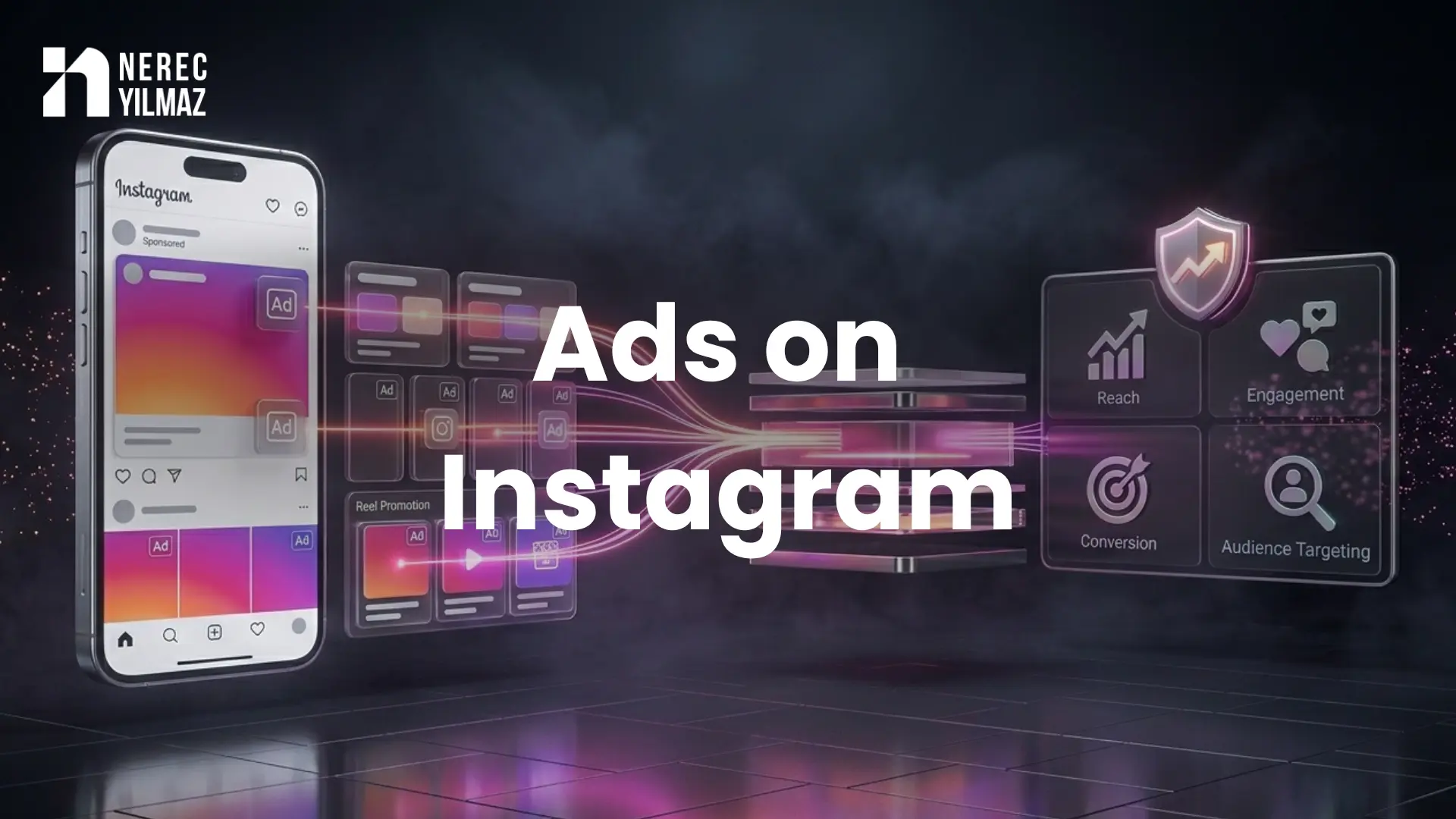
Ads on instagram is the process of purchasing paid visibility across placements such as Reels, Feed, Stories, and Explore by selecting objectives, audiences, budgets, and creatives through Meta Ads Manager (Facebook + Instagram + other Meta inventory). In 2026, the core of the process is not simply “running ads”; it is achieving sustainable results through the right objective + the right measurement setup (Pixel/CAPI) + the right creative testing system. Meta’s consolidation of campaign goals under 6 main objectives (Awareness/Traffic/Engagement/Leads/Sales/App Promotion) is the clearest example of this simplification.
Instagram ads can be used for many purposes, such as selling products/services, collecting forms (leads), generating messages (DM/WhatsApp), driving website traffic, and building brand awareness. But in 2026, results are largely determined by automation (Advantage+), measurement quality, and creative variety.
How Do You Advertise on Instagram?
The most accurate and flexible method is Meta Ads Manager; the fastest and most limited method is Instagram’s “Boost Post.” Both methods were explained in the previous content, and this distinction still applies in 2026.
1) Meta Ads Manager
Since objective, measurement, and optimization options are more advanced in Ads Manager, this is the main management panel in 2026. Campaign goals in Ads Manager are now grouped under 6 main objectives.
Step by step:
- Choose the campaign objective
Select the option that matches your business goal from Awareness, Traffic, Engagement, Leads, Sales, or App Promotion.
- Define the conversion location (critical for Sales/Leads)
Choose where the conversion will happen: Website / App / Messages / Calls / Instant Forms.
(Example: “Leads → Instant Form” or “Leads → Messages”.)
- Clarify the budget and bidding approach
In 2026, instead of using “overly narrow” restrictions, a cleaner setup usually performs better for algorithm learning in most accounts (especially new ones).
- Targeting and placements
The Advantage+ (automatic) targeting/placement approach is a strong starting point in many scenarios; custom restrictions should only be added when they are truly necessary.
- Creative and copy set
Instead of relying heavily on a single creative, testing with 3–5 variations provides healthier learning.
- Measurement and events (Pixel/CAPI)
If you are optimizing for sales or leads, the measurement layer (Pixel + CAPI) directly affects performance. In addition to Pixel, Meta explicitly recommends using the Conversions API.
The “campaign objectives” list in the old text now appears in a simpler structure within the new objective system on the Ads Manager side; this update is important for 2026.
2) “Boost Post” Through the Instagram App
Boost is practical for launching quickly, but it is more limited in terms of targeting, measurement, and optimization. The flow explained in the old content is still valid: business profile → select post → define objective → audience/budget/duration → publish.
You can think of Boost more as a “quick test” in scenarios such as:
- Pushing a new content format quickly
- Testing simple goals such as profile visits or DMs
Note: For more systematic sales/lead generation at scale, Ads Manager is generally the better choice.
Also see: An Additional “Location Tax” Is Coming to Meta Ads!
How Should Instagram Ad Objectives Be Chosen?
If the objective is chosen incorrectly, the algorithm will optimize for the wrong signal; therefore, you should first clarify your business goal and then select the correct one from the 6 objectives in Ads Manager.
- Sales: Conversion-focused actions such as e-commerce sales, add-to-cart, and purchases
- Leads: Lead collection through forms (instant form), messages (DM/WhatsApp), or calls
- Engagement: Upper-funnel behaviors such as video views, engagement, and follower growth
- Traffic: Website clicks, but focused on visits rather than sales
- Awareness: Reach/brand awareness
- App Promotion: App installs and in-app actions
Campaign Types Standing Out in 2026

Advantage+ approach (automation)
In 2026, Meta ads operate more through an “AI-powered automation” logic; a significant portion of targeting, placements, and creative distribution has become automated. Meta’s structures such as Advantage+ Shopping are the most visible example of this trend.
- In e-commerce: Campaigns such as Advantage+ Shopping offer automation advantages.
- On the lead generation side: 2025–2026 content frequently emphasizes that the logic of automation is also extending into lead campaigns (automation is expanding across the Meta ecosystem).
Click-to-Message / WhatsApp-focused campaigns
Campaigns that direct users to DM/WhatsApp can perform especially well in service-based industries in 2026; Meta also officially highlights growth on the click-to-message side.
Instagram Ad Formats
The formats in the old content are still the core building blocks (Story/Video/Image/Carousel). In 2026, their practical use has evolved as follows:
- Reels Ads: Vertical video + the first 2 seconds matter + clear CTA
- Story Ads: Full-screen, fast message, link/DM objective
- Carousel Ads: Product/service presentation + step-by-step storytelling + motivation to swipe
- Collection / catalog (if applicable): Strong for product discovery in e-commerce
Measurement in 2026: Is Pixel Alone Enough?
In many scenarios, Pixel alone may not be sufficient; Meta Pixel + Conversions API are recommended together.
Meta’s recommendation: use CAPI together with Pixel and apply best practices such as event deduplication (event_id).
Why is it important? More accurate measurement → more accurate optimization → more stable costs.
Instagram Advertising Costs in 2026
Instagram advertising costs cannot be explained with a fixed “average”; the industry, objective, creative quality, competition, timing (seasonality), and measurement quality determine the cost.
Since the “average cost per click / 1,000 impressions” ranges in the old content can vary greatly from account to account in 2026, the more accurate approach is to clarify the factors that affect cost.
The main factors that affect cost the most:
- Objective (Sales/Leads/Traffic)
- Creative quality (thumbnail/first 2 seconds/message clarity)
- Competition (industry and season)
- Measurement infrastructure (Pixel+CAPI)
- Landing page and conversion rate (if the site is slow, CPA can spike)
Conclusion
Advertising on Instagram is not just “pressing a button and publishing”; it is a growth process that requires budget, measurement, and a creative system. I do not provide paid ad management services, because in the long term, sustainable growth comes from growing “without becoming dependent on ads.” If you want to strengthen your brand’s visibility without ads and make organic reach more sustainable through Reels, Search, profile SEO, and content series, contact me within the scope of organic social media consulting, and let’s build a customized organic growth plan for your brand together.
FAQ
Is it mandatory to be a company to advertise on Instagram?
No. However, you do need a Business/Professional account and a payment method; if you are going to use Ads Manager, you also need a Business Suite/Ads account setup.
What is the difference between “Boost Post” and Ads Manager?
Boost is fast, but its options are limited; Ads Manager is more flexible in targeting, placements, measurement, and optimization.
Which objective should I choose in 2026?
Choose the one that matches your business goal: Sales for sales, Leads for forms/DMs, Awareness for visibility, Traffic for website visits. The objective list has been reduced by Meta to 6 categories.
How do you run ads that direct people to WhatsApp?
Click to WhatsApp / message-focused campaigns can be set up in Ads Manager.
Pixel or CAPI?
In most scenarios, the best practice is to use both together. Meta recommends using CAPI alongside Pixel and shares coverage/quality targets.